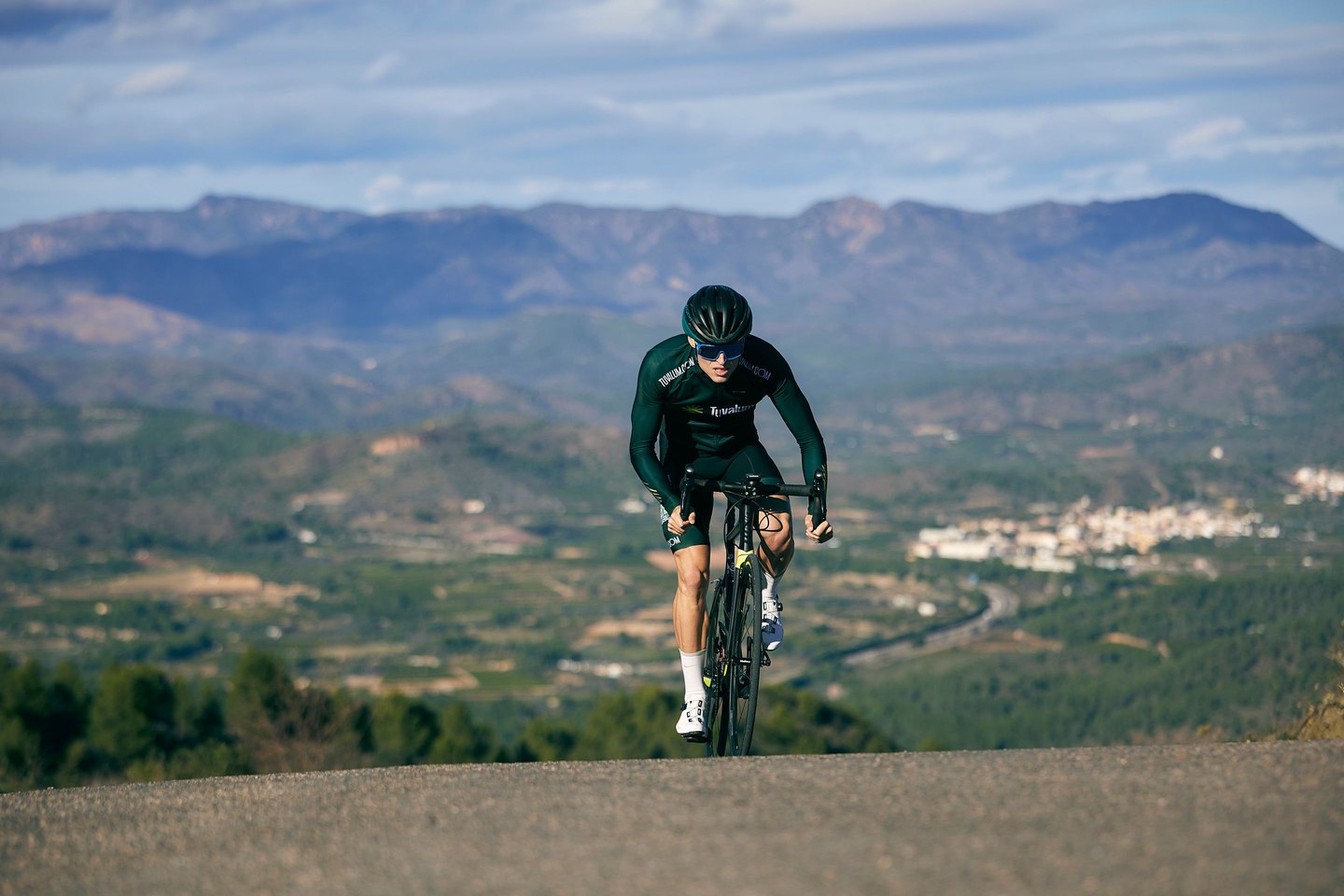
For road cycling
What you'd spend years picking up from whoever's wheel you sit on
How to train, fuel and taper for your race — and why.
No sign-up. Only you see your data. · See how it looks


Morning
Open it — and you know what to do today
Today's session, how long it takes and how many carbs to take before, during and after — on one screen.
Rides arrive on their own
via Intervals.icu
Garmin · Wahoo · COROS · Suunto · Polar · Zwift — via Intervals.icu, connect once
What one day looks like
Training, food and rest are worked out together, and every screen says the same thing.
Morning: today's ride
What to ride, how long and why — from your weekly plan, fitted to your form and free time.
Food for that ride
How many carbs (your main riding fuel) before, during and after the ride. Log food with a photo, no scales.
The plan adapts to real life
Missed a session or rode more than planned? The rest of your week is recalculated automatically.

Evening check-in: how did it feel?
Rate how hard it was from 1 to 10. If a session felt harder than it should, the next days get easier.
Everything around your training — in one app
Like a pro team: training, food and rest are worked out together, not in four different apps.

Today's training
What to ride, how long and why — from your weekly plan; before a race, a course breakdown.


Fuel for the work
How much carbs, water and salt before, during and after this exact session.

Recovery
How rested you are — from recent load and your evening rating.

Race preparation
Load builds week by week and eases off smoothly before a race.
Demo diary · one day
A tempo group ride. Here's what the app worked out for it.
Today: tempo · group ride 101 km
No extra tests
The app notices for you
The app notices when you've got stronger or tired, and suggests what to change in the plan.
From your best 2, 5 and 12 minutes over 90 days.
Update? I'll rebuild the plan →✓ Threshold 3 × 12 min — fully done
✓ VO₂max (short near-max intervals) 5 × 4 min — done too
The easy day had 28 min above Z2 (easy zone) — that's no longer recovery.
The same watts at a TSB above 5 felt 14% easier than at a TSB below −10 — from your own 21 days, not a textbook.
Same watts the next day: carbs on target ≥90% vs carbs under 75%.

Race on the calendar
A pro-team taper
Two weeks before a race, volume eases off smoothly while intensity stays — you get rested without losing form. Every number comes from research; code does the arithmetic, the AI only puts it into words.


Race plan — like a pro team
The night before the start, the sports director breaks the race down: where it will be decided, where to save energy, where to attack, what to eat and drink. Now you get that briefing too.
See an example →
Personal patterns
Over time the app learns how you work
After a few weeks of ratings you see what works for you — for example, on which days the same effort feels easier.
It takes 8 pairs of days with effort ratings — 4 in each half of the comparison.
Demo diary: compared 15 days of “above the neutral band” with 6 days of “below the neutral band”.
Open in the demo →Rider passport
What kind of rider are you
Your type is worked out from your best power in the last 90 days over 5 seconds, 1 minute, 5 minutes and at threshold — compared with other riders who train with a power meter.
stronger than 80% of riders
≈ stronger than 69% (between tables)
≈ stronger than 69% (between tables)
stronger than 60% of riders
≈ stronger than 71% (between tables)
≈ stronger than 65% (between tables)
stronger than 66% of riders
≈ stronger than 61% (between tables)
≈ stronger than 60% (between tables)
≈ stronger than 61% (between tables)
stronger than 52% of riders
your average · number under each duration — W/kg
Sprinter
Strongest at 5 seconds — the finishing kick.
Puncheur
Strongest at about one minute — an explosive attack on a short, steep climb.
Attacker
Strongest at about 5 minutes — attack off the front and stay away.
Climber / rouleur
Strongest at threshold — long climbs and a steady pace.
All-rounder
Every duration at the same level — no single strength.
Your type and chart appear from rides with a power meter: at least three of the four durations are needed — 5 seconds, 1 minute, 5 minutes, threshold.
The project's first rule
“No made-up numbers.”

Gregarion is built by a road racer — for himself and riders like him. No made-up numbers: every piece of advice on watts, carbs and rest comes from published research or from your own rides. The method page shows where each number comes from. Read the method →
FAQ
Where do my rides come from?
Rides arrive on their own through Intervals.icu: connect Garmin, Wahoo, COROS or Zwift to it for free, then connect Intervals.icu here. A direct Garmin connection will be available when Garmin reopens its developer program; food is logged from a photo.
Where do the numbers come from — does the AI make them up?
No. Load, fitness and freshness (CTL, ATL, TSB) follow the Banister model pro teams use; power zones follow Coggan; the race taper follows the Bosquet et al. (2007) meta-analysis. Fueling and hydration follow Burke, the IOC position stand and ACSM. Code does the arithmetic; the AI only puts it into words.
Does this replace a coach?
The staff does a coach's weekly work: it builds a plan that grows your fitness, sets the day's session every morning, and rebuilds the week around what actually happened. If a race is coming, it runs the taper into the start.
How much time per day?
In the evening, one answer about how the session went, and a photo of your food — the only things the staff can't see on its own. The rest is computed by code, and rides arrive on their own through Intervals.icu.
Do I need to sign up?
No. The diary starts with your first entry and lives in this browser. Email only links the same diary across your phone and computer — a one-time link, no password.
What if I skip a day?
Nothing breaks. A gap in the food log is never read as under-eating and never cuts your training. The plan rebuilds around what actually happened.

The app starts working from your first entry
No sign-up. Only you see your data.
We'll write once when Garmin opens the connection.
What's unclear, what's missing, what broke — we read everything.